Rope Access vs. Scaffolding: What the Real Cost Difference Means for Your Reserve Fund
Rope Access vs. Scaffolding: What the Real Cost Difference Means for Your Reserve Fund
When your board receives competing bids for exterior maintenance work on a South Florida high-rise, rope access is almost never the lowest number on the page. Scaffolding and bosun chair contractors routinely undercut it by 20 to 30 percent — on paper. What those bids don't show is where the remaining budget actually goes, and what the building absorbs in risk when the crew leaves. This article breaks down the real cost comparison so your board can evaluate bids on equal terms.
What the Bid Sheet Doesn't Capture {#what-the-bid-sheet-doesnt-capture}
A bid for exterior building maintenance contains a number. What it rarely contains is a breakdown of how that number is structured — specifically, what percentage goes to accessing the building versus actually performing the work.
This distinction matters more than most boards realize. For any method that requires erecting a structure before work can begin, a portion of every dollar approved goes to logistics, not output. That portion is not recoverable. The building pays it regardless of whether the underlying work is done well or done at all.
Rope access eliminates that category of cost entirely. The access method and the work method are the same system. Understanding why changes how your board should read every future exterior maintenance bid.
The Scaffolding Cost Breakdown: Where the Budget Goes Before Work Begins {#the-scaffolding-cost-breakdown}
Scaffolding is a construction infrastructure project attached to a maintenance project. Before any technician touches your building envelope, the board has already funded:
Erection and Dismantling Labor
Scaffolding requires a dedicated crew to assemble the system, a permit process in most South Florida jurisdictions, and a second crew to dismantle it when the job is complete. This labor produces no maintenance output. It exists solely to create access.
Permit and Inspection Fees
Miami-Dade, Broward, and Palm Beach counties each have permit requirements for exterior scaffolding on occupied residential structures. Fees vary by project scope, but they are a fixed overhead cost that has no equivalent in a rope access operation.
Equipment Rental Duration
Scaffolding rental is time-based. Delays — weather, inspection holds, scope changes, crew availability — extend the rental period and the associated cost. In South Florida's hurricane season window, weather delays are not rare. Every additional day the system sits idle costs the building without advancing the work.
The Aggregate Effect
Industry estimates consistently place scaffolding overhead at 30 to 40 percent of total project cost for high-rise applications. On a $200,000 exterior restoration project, that means $60,000 to $80,000 is spent before a single linear foot of facade is addressed. That is capital drawn from reserve funds that produces no asset improvement.
Key Insight: The scaffolding bid isn't competing with the rope access bid on labor and materials. It's competing on a fundamentally different cost structure — one where access itself consumes a third of your budget.
How Rope Access Changes the Budget Equation {#how-rope-access-changes-the-budget-equation}
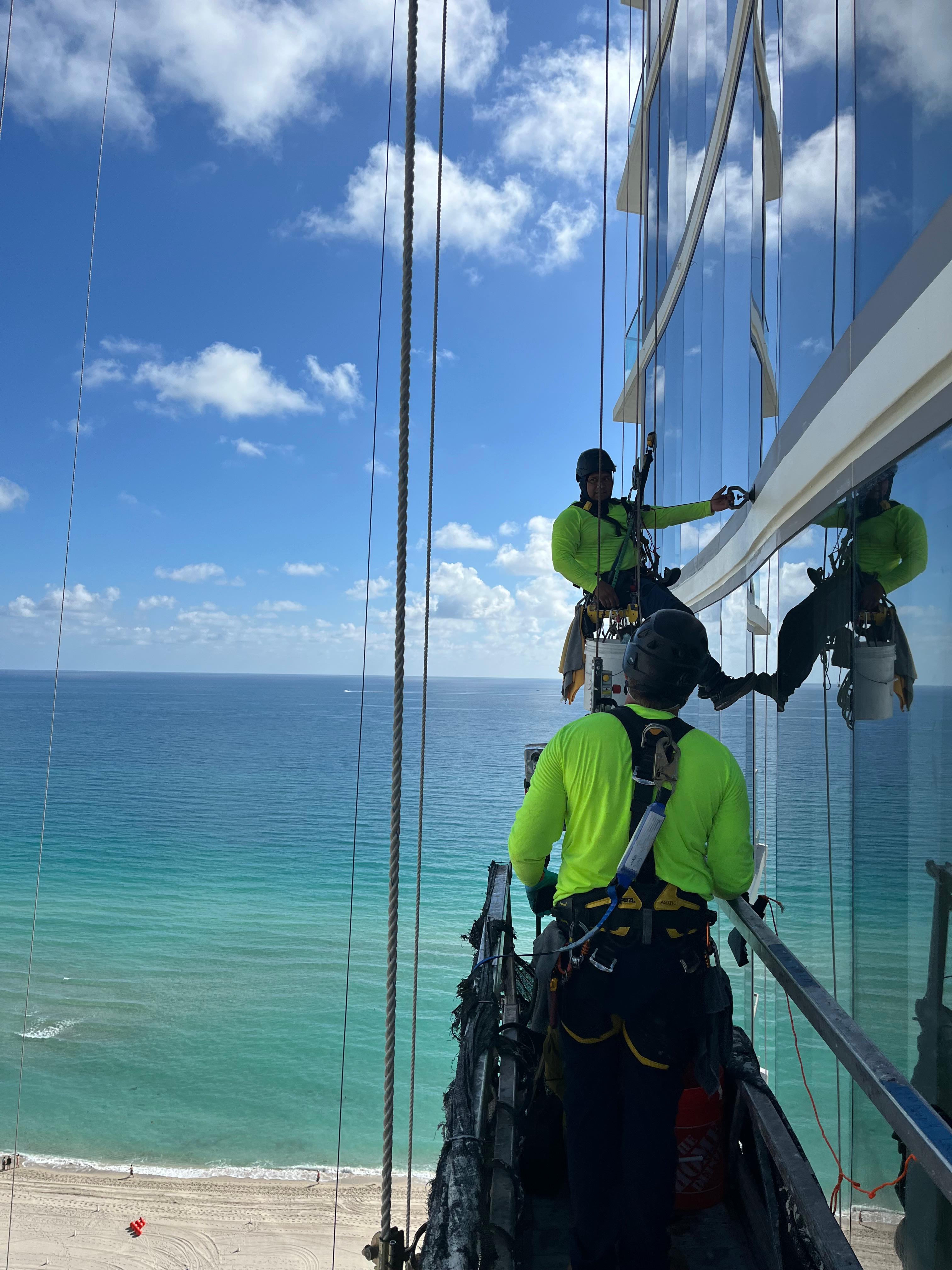
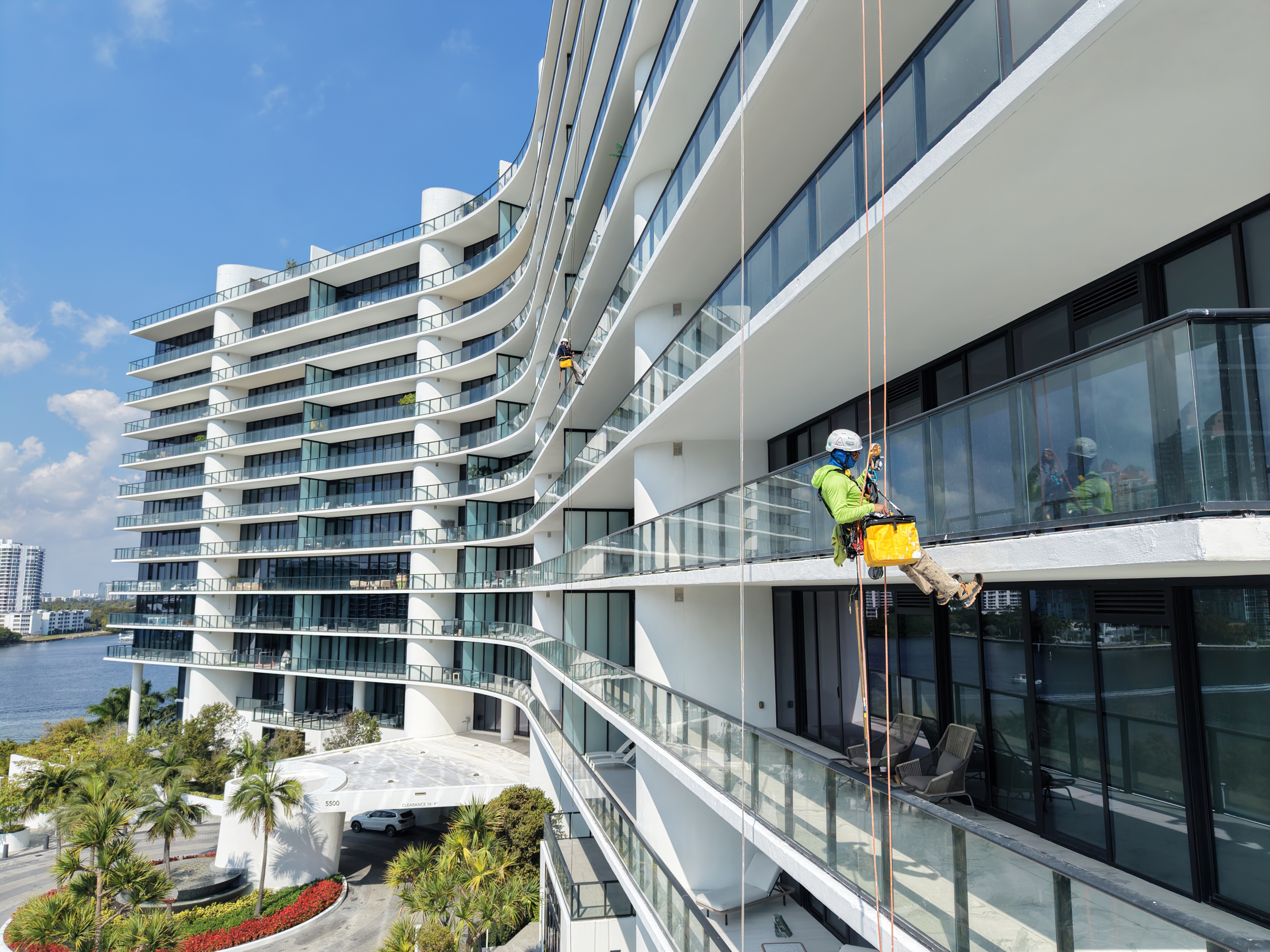
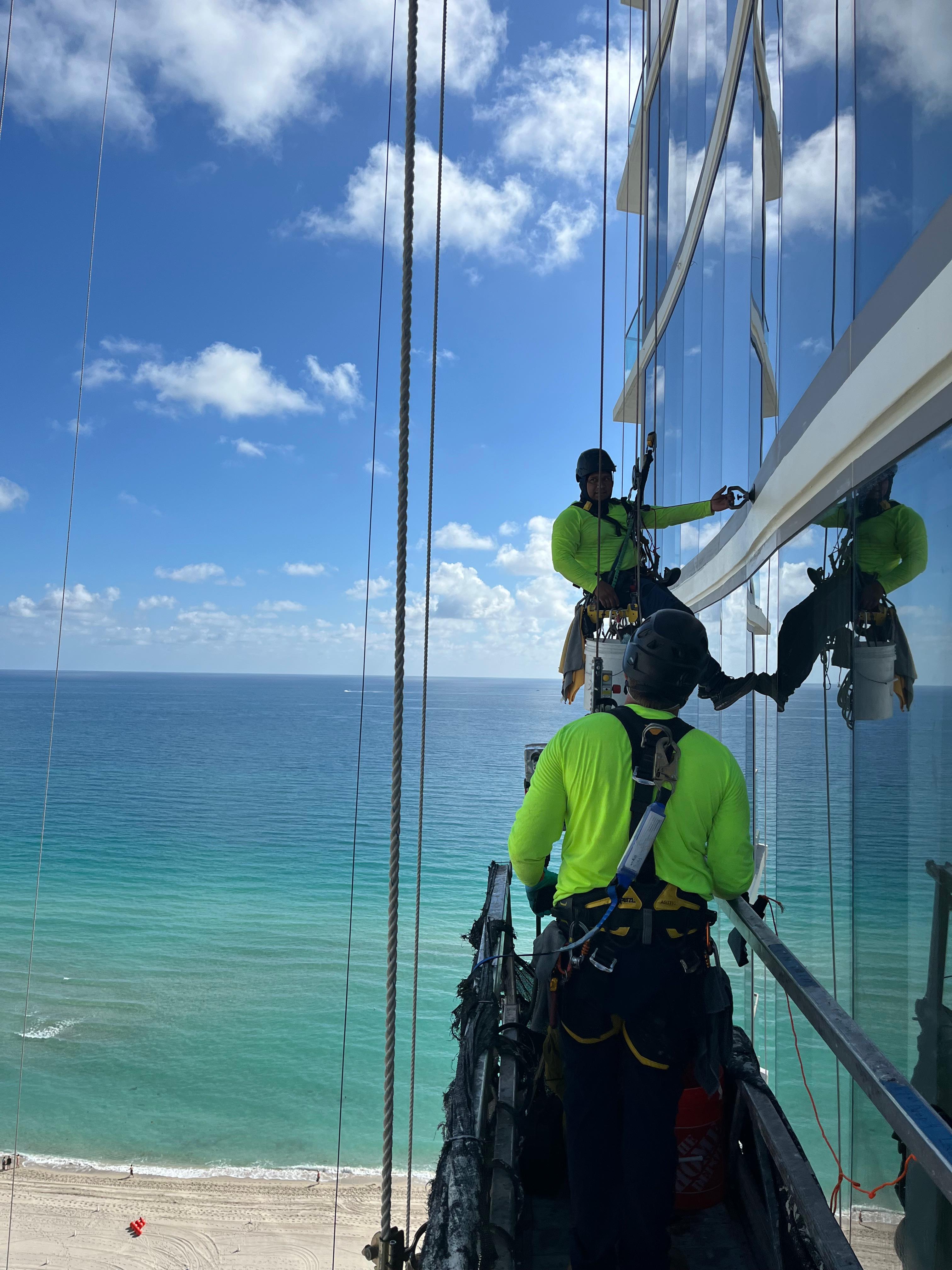
Industrial rope access — the engineering-grade method certified under IRATA and SPRAT standards — deploys technicians directly from anchor points at the roof level. There is no scaffolding to erect, no rental clock running, and no dismantling phase.
Budget Allocation
When access overhead is eliminated, the approved project budget allocates almost entirely to labor and materials. A board approving $200,000 for rope access exterior work is funding $200,000 of actual work, not $200,000 minus the cost of getting there.
Schedule Compression
Rope access teams mobilize and demobilize within a single shift. There is no multi-day setup phase. For buildings with time-sensitive compliance deadlines — particularly Florida's SB 4-D Milestone Inspection requirements — schedule compression can be operationally critical, not just financially convenient.
Scope Flexibility
Because access does not require a fixed structure, scope adjustments during execution are handled without re-engineering the access system. If an inspection reveals additional deterioration that wasn't visible from street level, a rope access team can address it within the same mobilization. Scaffolding changes require structural modification of the system, often with permit implications.
The Hidden Liability Cost That Boards Rarely Price In {#the-hidden-liability-cost}
Reserve fund impact is one dimension of the cost comparison. Insurance exposure is another, and it's the one most boards don't evaluate until they need it.
Workers' Compensation Classification
Florida contractors are legally required to carry Workers' Compensation insurance. What most boards don't verify is the classification code under which that coverage is written.
Contractors operating bosun chairs — single-line descent systems — frequently carry Workers' Comp classified under janitorial or general cleaning codes. These codes have lower premiums than the correct classification for exterior high-rise access work. If a worker is injured while operating under an incorrect classification, the insurer has grounds to deny the claim. When coverage is denied, the liability exposure transfers directly to the property — and in HOA structures, to the board members who approved the contract.
Rope access contractors certified to IRATA or SPRAT standards carry Workers' Comp classified correctly for industrial rope operations. The premium is higher. The coverage is real.
Certificate of Insurance vs. Actual Coverage
A certificate of insurance confirms that a policy exists on a specific date. It does not confirm that the policy covers the specific type of work being performed at your property. Boards that accept COIs at face value without verifying scope coverage and classification codes are accepting unknown liability, not managing it.
For a full breakdown of what insurance verification should actually look like before any exterior contractor begins work, see What "Fully Insured" Actually Means — and What It Doesn't.
Operational Disruption: The Cost Your Residents Will Notice {#operational-disruption}
Reserve fund drawdown and liability exposure are board-level concerns. Scaffolding creates a third cost category that residents experience directly.
Ground-Level Impact
Scaffolding structures require a controlled drop zone at the building perimeter. In high-density South Florida properties — Brickell, Sunny Isles, Fort Lauderdale Beach — that zone typically intersects with valet lanes, resident parking, or pedestrian access. The operational disruption lasts for the full duration of the scaffolding rental period, not just the days when active work is occurring.
Noise and Resident Complaints
Scaffolding erection and dismantling generates sustained mechanical noise. For occupied residential buildings, this produces resident complaints that flow to the property manager and, in many cases, to the board. Managing complaint volume is an indirect cost of the project that doesn't appear on any bid sheet.
Rope Access Zero-Footprint
Rope access technicians descend from the roof. They do not interact with ground-level infrastructure. Valet operations continue. Resident access is uninterrupted. The only visible sign of the operation from ground level is the presence of a dedicated ground supervisor managing the drop zone — a safety protocol, not a disruption source.
When Scaffolding Is the Right Call {#when-scaffolding-is-the-right-call}
A complete cost comparison requires acknowledging where scaffolding maintains a legitimate advantage.
For restoration projects requiring sustained heavy tool use at a fixed elevation — large-area concrete demolition, for example — scaffolding provides a stable platform that reduces technician fatigue over extended periods. Projects that require simultaneous multi-trade access at the same elevation (structural repair plus waterproofing plus painting in a single continuous operation) can be logistically simpler with a fixed platform in place.
The relevant question for your board is not "which method costs less?" It is "which method is appropriate for this specific scope, and what does the full cost of that method actually include?"
For the majority of South Florida high-rise maintenance work — window cleaning, glass restoration, caulking, waterproofing, concrete spalling repair, painting — rope access is the more cost-efficient method once the complete cost picture is on the table.
Frequently Asked Questions About Rope Access vs. Scaffolding in South Florida {#faq}
Is rope access actually safe compared to scaffolding for high-rise work? Certified industrial rope access under IRATA or SPRAT standards has a documented safety record that compares favorably to scaffolding for high-rise applications. Scaffolding is a structural system subject to assembly error and wind load stress — relevant concerns in South Florida's High-Velocity Hurricane Zone. Rope access systems are deployed and retrieved daily, with no permanent structure left exposed to weather conditions.
How much can a building realistically save by choosing rope access over scaffolding? Project-specific savings vary by scope and building height. On projects where scaffolding overhead typically represents 30 to 40 percent of the total bid, the cost reduction available through rope access is proportional to that overhead. For high-rise buildings in Miami-Dade, Broward, and Palm Beach counties, that difference on mid-size projects can range from tens of thousands of dollars upward depending on project scope.
Does rope access work for SB 4-D Milestone Inspections? Yes. Florida's SB 4-D Milestone Inspection requirements call for hands-on facade access to support the engineer of record's inspection process. Rope access teams provide the certified access while the licensed structural engineer directs the inspection. The combination meets the statutory requirement and typically schedules faster than scaffold-based access, which is relevant given current compliance deadlines.
What should an HOA board verify about a rope access contractor's insurance before signing? Verify that Workers' Compensation is classified under a code appropriate for high-rise rope access work — not janitorial, not general cleaning. Verify that General Liability coverage specifically includes rope access operations. Request confirmation that the certificate of insurance is current and that the policy covers the specific scope of work at your property address.
Can rope access handle large restoration projects, or only routine cleaning? Industrial rope access handles the full range of exterior building maintenance: window cleaning, glass restoration and polishing, concrete spalling repair, waterproofing and caulking, exterior painting, and facade inspections. The method's limitation is not scope — it's platform stability for specific sustained heavy operations. For the majority of high-rise maintenance work in South Florida, rope access is a complete solution, not a specialty option.
How does rope access affect the building's SB 4-D documentation trail? Certified rope access contractors generate daily execution logs and a close-out report with before-and-after documentation, access records, and technical observations. This package supports the paper trail that HOA boards and their legal counsel need for due diligence documentation under Florida's current inspection and maintenance requirements.
Get a Cost Comparison for Your Property
If your board is evaluating competing bids for exterior work and wants to understand the full cost structure — not just the bottom line — RIG Access provides project assessments for high-rise properties across Miami-Dade, Broward, and Palm Beach counties.
The right question isn't which bid is lower. It's which bid is telling you everything.
Related reading:
Published by RIG Access Group | South Florida High-Rise Maintenance