What "Fully Insured" Actually Means — and What It Doesn't
When a property manager or HOA board requests proof of insurance from a contractor, there is usually one goal: get the certificate, confirm the boxes are checked, move the project forward.
It is a reasonable process. The problem is that a certificate of insurance confirms a policy exists. It does not confirm that policy covers the specific work being performed on your property.
That distinction matters more than most people realize.
The certificate is not the coverage
A Certificate of Insurance — the COI most contractors provide — is a summary document. It shows policy types, limits, and effective dates. What it does not show is what is actually covered under each policy.
Two contractors can hand you nearly identical certificates. Their actual coverage in the event of a claim can be very different.
Here is why.
1. General Liability covers property damage — but not always what you think
General Liability is the policy most people think of first. It covers third-party bodily injury and property damage caused by the contractor during the work.
But exclusions vary by policy. Some policies exclude work performed at height above a certain elevation. Others exclude damage to the specific surface being worked on. A few exclude coverage for work on structures that are occupied at the time of service.
Before a contractor accesses your building’s exterior, it is worth asking: does your General Liability policy contain any exclusions relevant to this scope of work?
A qualified contractor should be able to answer that clearly.
2. Workers’ Compensation depends on the class code
This was introduced in the previous article, but it deserves more attention.
Workers’ Compensation reimburses injured workers for medical expenses and lost wages. But the coverage applies based on how the worker is classified — the class code assigned to their role.
A worker classified under a general maintenance or janitorial code carries a lower premium than one classified under a high-risk, at-height industrial code. That premium difference reflects a corresponding difference in coverage.
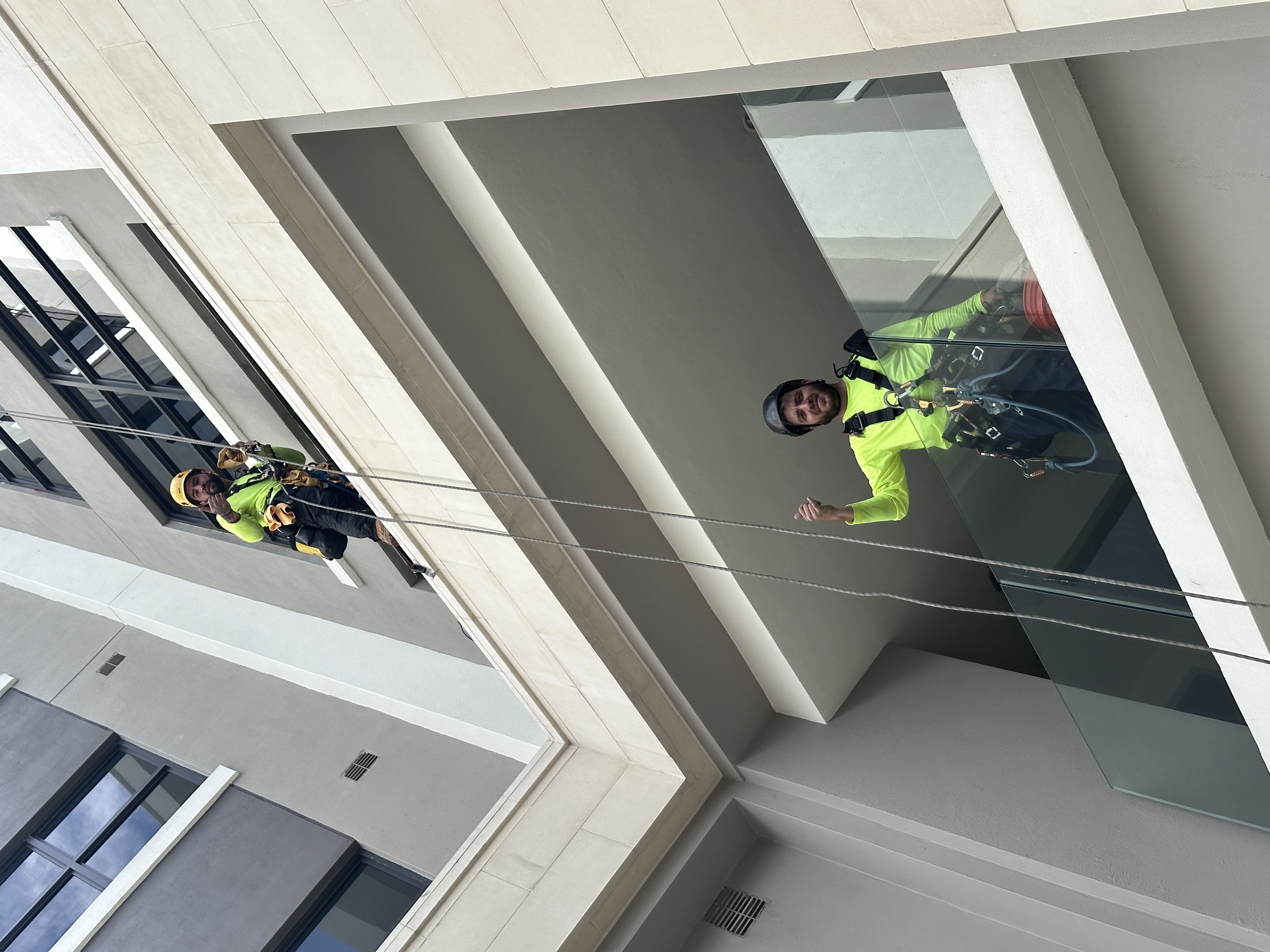
If a technician is performing rope access work at the 25th floor under a ground-level classification and a claim is filed, the insurer has grounds to dispute coverage. The work does not match the classification. The policy was not priced for that exposure.
In that scenario, the injured worker may still have a claim. The question is who that claim ultimately reaches.
3. The Additional Insured endorsement — and why its absence matters
Many property management contracts require contractors to name the property or association as an Additional Insured on their General Liability policy.
This is not a formality.
Additional Insured status means that if a claim arises from the contractor’s work, the property’s own insurance carrier does not have to respond first. The contractor’s policy is primary.
Without it, a claim resulting from exterior work on your building may trigger your property’s own insurance — raising your premiums and opening your organization to direct exposure even if the contractor caused the loss.
The certificate should explicitly show the property or association listed as Additional Insured. If it does not, that is worth raising before the project begins.
4. Umbrella and excess coverage — what sits above the primary limits
General Liability policies carry per-occurrence and aggregate limits. On large commercial projects, a single incident can approach or exceed those limits.
Umbrella and excess liability policies provide coverage above those thresholds. Not every contractor carries them. The ones who do typically reflect a more mature risk management posture.
It is worth asking: what are your policy limits, and do you carry umbrella or excess coverage?
The pattern here
Checking for insurance is the right instinct. The checklist most people use is just too short.
A certificate confirms a policy was active on a given date. It does not confirm that the scope of work is covered under the policy terms, that workers are classified correctly for the work being performed, that the property is protected as an Additional Insured, or that the limits are sufficient for the scale of the project.
None of these questions are adversarial. Any contractor with serious coverage should be able to answer them without hesitation. The ones who can’t — or who treat the questions as an inconvenience — are communicating something important about how they manage risk overall.
Insurance is not a box to check. It is a system designed to protect specific parties from specific events. Whether it actually does that depends entirely on the details.
RIG ACCESS Vertical Solutions provides Engineering-Grade Industrial Rope Access for high-rise properties across Miami-Dade, Broward, and Palm Beach counties.